
July 30, 2026
When Tracking Actually Changes Behavior, and When It Doesn't
The honest version of what self-monitoring can and cannot do. When tracking actually changes what you do, when it only changes what you notice, and when it quietly backfires.
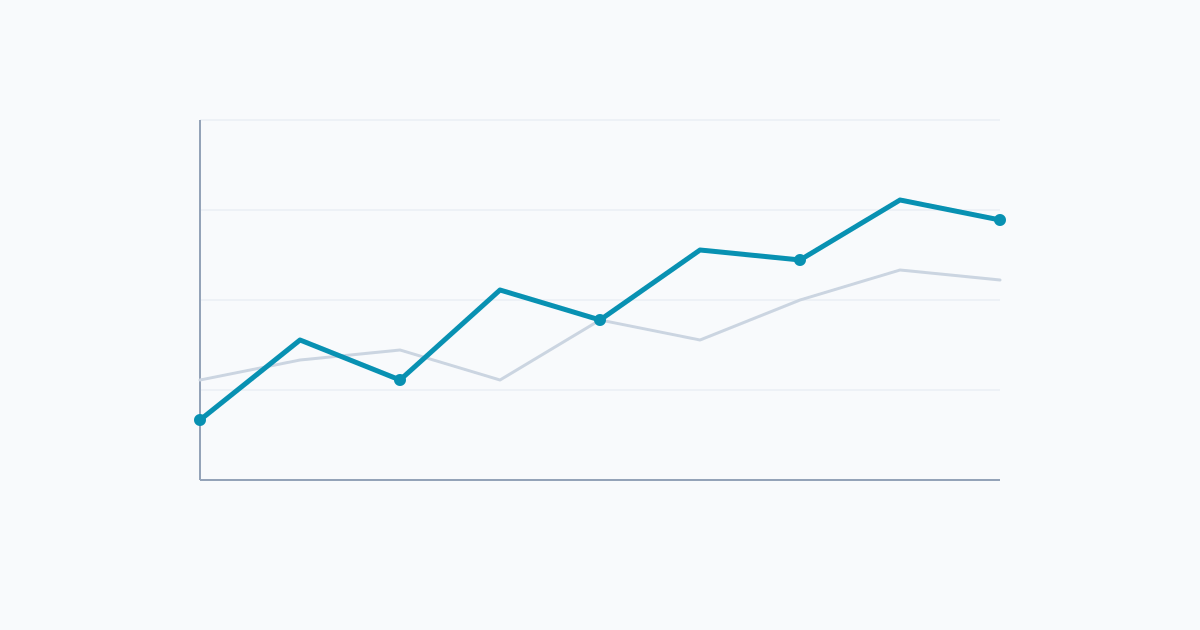
Ask someone who has been tracking honestly for a year what changed because of it. You will hear, more often than not, some version of this: “The data did not really change my behaviour. It changed what I notice.” That answer is unsatisfying if you came in hoping a tracker would fix your sleep, your focus, or your weekday energy. It is also closer to the truth than most productivity writing will admit.
This article is the honest version: when tracking actually changes behaviour, when it only changes attention, when it backfires, and what you can realistically expect after a few months of careful logging.
The conventional wisdom, and where it bends
“What gets measured gets managed” is the line most people inherit. It is half right.
When you measure something, you become aware of it in a way you were not before. That awareness sometimes changes the behaviour and sometimes does not. The slogan flattens those two outcomes into one. The trouble starts when the reader expects measurement alone to do the work. Measurement is an input; it has to be combined with attention, an honest reading, and usually a small change in something you control. Without those, the measurement sits there, accurate and inert.
Tracking is genuinely useful. It is just useful in narrower and quieter ways than the slogan suggests.
When tracking actually changes behaviour
There are real cases where logging changes what you do, sometimes within days. They share a structure: the data either lands in the moment of choice, or it contradicts a story you were telling yourself.
When the act of logging makes you aware in the moment
You are about to pour a third coffee at 5pm. You open Loggr to log the second cup you had at 2pm, and the act of reaching for the field puts the question in front of you. Do I want this third cup, or am I doing it on autopilot? Some days you have it anyway. Some days you do not. Either way, the choice became a choice.
Notice that you did not need to look at the data. The act of logging was the intervention. This is the most underrated way tracking changes behaviour, and it is the reason apps that auto-track silently in the background are often less behaviourally useful than they sound. The friction of logging is part of the value, because the friction creates the pause.
When the data reveals something you would never have noticed
“Days I sleep less than six hours, my afternoon is always bad.” You probably knew sleep mattered. You did not know the threshold was that sharp, or that it was that consistent. Once you see the pattern, your afternoon planning shifts. You move the meeting that needs a clear head to a different day, or you protect the prior evening, or you simply lower your expectations of the post-2pm hours after a short night.
The behaviour change here is small and concrete. Not “I will sleep better forever.” Just: “I will treat low-sleep afternoons differently, because I now know what they cost.”
When the data contradicts a story you were telling yourself
“I am a night owl who functions fine on five hours” is a common one. So is “caffeine after 4pm does not affect my sleep.” Stories like that survive on selective memory. They rarely survive eight weeks of honest data showing the opposite.
When a long-running belief breaks against the data, the behaviour change can be sudden. Not because the data is magic, but because the story was the load-bearing piece. Remove the story and the behaviour was already ready to move.
When tracking exposes a leverage point you did not see
“Wednesday is consistently my worst day, and it has been for months.” That is a finding. It does not tell you what to fix, but it tells you where to look. Maybe it is something about Tuesday evening. Maybe it is the meeting schedule. Maybe it is a recurring task you have learned to dread. Without the pattern, the bad Wednesday felt like noise. With the pattern, you have a thread to pull.
When tracking does not change behaviour
This list matters as much as the first one, and it gets glossed over more often. There are honest situations where careful logging produces useful description but no behavioural shift, and that is not a failure of the practice.
When the behaviour is driven by something the data does not capture
Stress at work is the easy example. If your mood field is at 4 every Tuesday because your standing 9am meeting is rough, no amount of sleep, exercise, or caffeine logging will surface that. The cause is outside the dataset. You can guess at it, but the data will keep pointing at whatever you are tracking, not at the meeting.
Tracking only shifts behaviour when the cause is somewhere in what you measure, or near enough to it. Causes that live outside the dataset stay invisible to the dataset, no matter how many fields you add.
When you already knew the answer
A surprisingly common finding: the data confirms what you suspected. “Days I exercise, my mood is better.” Most people knew that before they started logging. The confirmation is honest, but it is also not new information, and information that is not new rarely changes behaviour. The reason you were not exercising on the bad days was not lack of evidence. It was something else.
This is fine. Confirmed beliefs are a normal output of personal analytics, and they are part of the value, not a waste. They just do not produce dramatic before-and-after stories.
When the change required is not data but conviction
You can know, with high confidence, that your low-energy hours are 2pm to 4pm. You can have eight weeks of data showing it. And you can still book meetings during those hours, because saying no is hard, because the calendar is shared, because the person asking is your boss. The blocker is not awareness. It is the conversation you have not had, or the boundary you have not held.
Tracking is not a replacement for the harder, non-data parts of a life. When the change required is a small piece of conviction, the data sits there until the conviction shows up. Sometimes that takes years. The data is patient.
When tracking backfires
The honest version has to include this part. There are specific failure modes that turn a useful practice into a worse one.
Streak gamification
Streak counters work for the first few weeks, then quietly start to hurt. The behaviour stops being meditation and becomes “do something so the streak does not break.” The metric becomes the goal. We took this apart in detail in our piece on habit tracking without streaks; the short version is that any feature that optimises for the streak ends up corrupting the underlying data and, often, the underlying habit.
Excessive logging turning life into a measurement exercise
Twenty fields, three reminders a day, a feeling of being behind on your own life. We covered this in the sustainable-practice piece on quantified self without burnout. When logging takes longer than the value it returns, the practice flips from useful to extractive. People quit, usually around month four, often with a small layer of guilt about it.
Reading correlations as causes
“On days I drink 12 glasses of water my mood is higher, so I should drink 12 glasses of water.” The correlation is real. The causal claim is a leap. The original observation might have been a coincidence, a third variable (calm days are also water days), or reverse causation (calm days are easier to remember the bottle). Acting on the leap leads to misguided changes that do not produce the result you were promised. Our deeper read of this is in correlation vs causation in personal data.
Tracking the wrong metric
If “happiness” is your outcome, no input field is going to give you a clean answer. The outcome is too composite, the measurement too vague, the day-to-day variance too high. You can track happiness, and the description is useful, but expecting a causal lever to fall out of the data is unrealistic. The same goes for “creativity,” “productivity,” and any outcome that is really a bundle of things wearing one label.
The fix is to track narrower outcomes. Energy at 3pm. Focus during the morning block. Mood on Sunday evening. Narrower outcomes give the data something to attach to. Broader ones absorb the data and stay vague.
The shift from “tracking changes behaviour” to “tracking changes attention”
If you log honestly for several months, the experience shifts. Early on, you might expect the data to point at a fix. Later, you stop expecting that and start using the data differently. You notice the Wednesday pattern, the post-lunch dip, the way your mood scores cluster around certain weeks. The data does not directly change what you do. It changes what you watch.
That is enough. It is not the transformation arc productivity writing promises, but it is a real, durable benefit, and it survives the months and years that the dramatic promise does not.
People who have been logging for a year or more usually describe this shift without prompting. The first six weeks are about the novelty and the early surprises. The next few months are about adjusting expectations downward. From month six onward, the practice settles into something quieter: attention, slow self-knowledge, fewer surprises.
The Hawthorne effect, honestly
People behave differently when they know they are being watched, even by themselves. This is the Hawthorne effect, and it shows up in personal tracking in a specific way.
Logging mood often improves mood for the first two or three weeks just because you are paying attention to it. Logging caffeine often reduces it for a similar window. Logging exercise often nudges it up. None of these are evidence that the tracker works in a deep sense. They are evidence that fresh attention changes a few weeks of behaviour, after which the change fades and the underlying signal is what is left.
The honest reading of an early-period improvement is “this is partly the act of paying attention, and the data will settle in a month or two.” Patterns that survive that settling are meaningfully different from patterns that show up in the first fortnight. A pattern that holds across two months has earned more weight than one that appeared in week three.
What you can actually expect
Not transformation. Modest, slow self-knowledge. A few small behaviour changes that come from specific findings. A clearer sense of your own week. The end of one or two stories you were telling yourself that were not quite true. The ability to plan around your own patterns without pretending you can override them.
That bargain is the one worth signing up for. The reader who shows up to it stays for years. The reader who expects “Loggr fixed my sleep” leaves disappointed in week six, usually with a small layer of self-blame that is not deserved, because the promise was overstated to begin with.
If a month into tracking nothing dramatic has changed in your behaviour, that is the normal experience. Look at what you have started noticing instead. That list is usually longer than you expect.
FAQ
Should I track if I am not planning to change anything?
Yes. Awareness is a valid outcome on its own. People who log for years often describe a sense of “knowing my own week” that they would not trade, even though the actual behaviour changes have been modest. Tracking does not have to lead to action to be worthwhile.
What if my data does not show any pattern?
Also a finding. The absence of a pattern is information, especially if you logged long enough for one to have surfaced. It might mean the cause is outside what you tracked, or that the noise is bigger than the signal in this period of your life, or that the question you were asking does not have a clean answer in your data. None of those are failures.
Should I share my data to motivate myself?
Only if it works for you specifically. Some people are genuinely motivated by accountability. Others find sharing turns a quiet personal practice into a performance, which then distorts the data. There is no universal answer, just your own experiment.
Can apps that auto-track without logging be more effective?
No. The act of logging is part of the value. Auto-trackers produce data without producing the pause-and-notice moment that often is the behaviour change. If you only want description, auto-tracking is efficient. If you want the practice to nudge behaviour, manual logging is the better tool.
How long before I should expect any behaviour change at all?
For act-of-logging moments, often within the first week. For pattern-driven changes, usually a month or two, sometimes longer. For the deeper shift to “this changes my attention, not my actions,” somewhere between three and six months.
Key takeaways
- “What gets measured gets managed” is half right. Measurement creates awareness; awareness sometimes changes behaviour and sometimes does not.
- Tracking actually changes behaviour when the act of logging lands in a moment of choice, when the data reveals something genuinely new, when it contradicts a story you were telling yourself, or when it exposes a leverage point.
- Tracking does not change behaviour when the cause is outside the dataset, when you already knew the answer, or when the change required is conviction rather than data.
- Tracking backfires when streaks distort the signal, when excessive logging turns life into a measurement exercise, when correlations are read as causes, or when the metric is too broad to attach to.
- Over months, the experience shifts from “tracking changes behaviour” to “tracking changes attention.” That is enough, and it is the durable benefit.
- The Hawthorne effect lifts the first two or three weeks of any new tracking practice. Patterns that survive the settling are the ones worth taking seriously.
- Realistic expectation: modest, slow self-knowledge, a few specific behaviour shifts, a clearer sense of your own week. Not transformation.
If you have been tracking for a month and nothing feels different
That is normal. Open your logs and look at what you have started noticing, not at what you have changed. The list is usually longer than you expect, and it is the part that compounds over time. Open Loggr if you want to begin from scratch, or keep going with the practice you have. Six field types, on iOS, Android, and web, the same data on every device. The behaviour changes that happen, happen slowly. The attention shift happens sooner, and it is the part that lasts.