
June 23, 2026
Habit Tracker Without Streaks: Why the Counter Stops Helping, and What to Use Instead
Streak counters work for the first few weeks, then quietly start to hurt. Here is why the number gets in the way, and the metrics that actually tell you whether the habit is sticking.
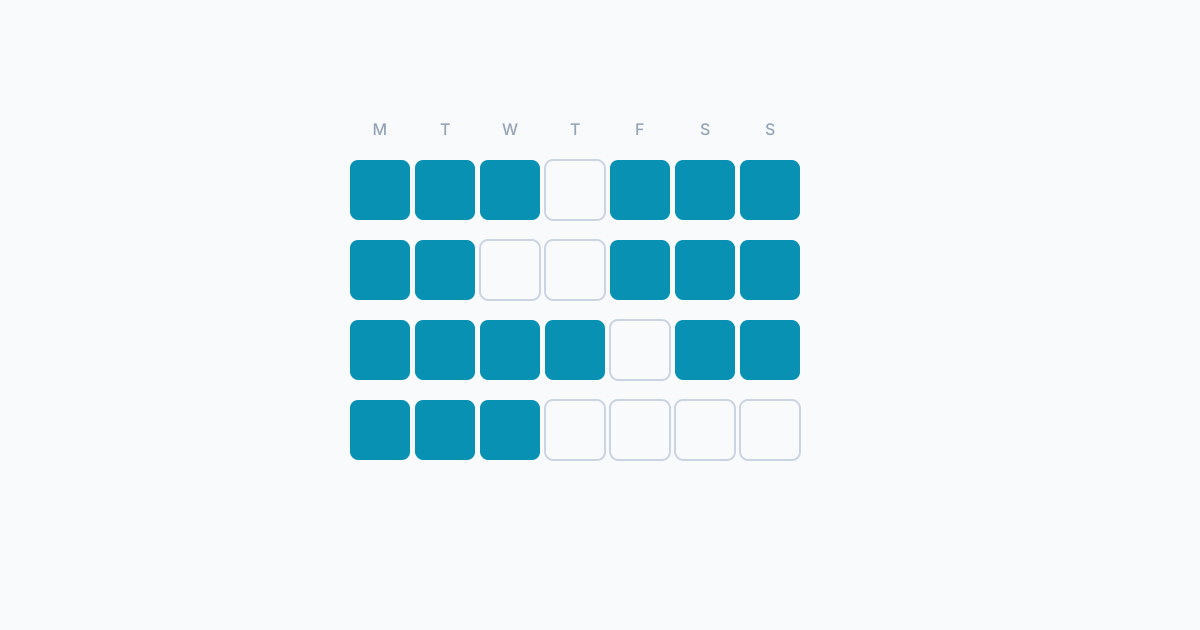
You meditated seventeen days in a row. The counter said 17. You were proud of it. On day eighteen, life happened. A late meeting, a sick kid, a flight, a bad mood. You missed. The counter reset to zero. By the end of the week you had stopped opening the app. The streak that was supposed to build the habit became the reason you walked away from it.
That is the streak trap. It is the most common way well-meaning habit tracking quietly fails, and it has very little to do with willpower. This article is about why streak counters stop helping after a few weeks, what to look at instead, and how to think about consistency in a way that survives a bad Tuesday. If you are newer to all this, our calm guide to personal analytics is a good place to start, and this article picks up from there.
Why streak counters were invented
Streaks are not a scam. It is worth saying that out loud before taking them apart.
A streak counter is a simple, visible reward. It gives you a single number that goes up every day you do the thing, and the up-and-to-the-right feeling is genuinely motivating, especially in the first few weeks of a new habit. The brain likes a clean game. A streak turns “did the thing” into a clean game.
For brand-new habits, this matters. The first three weeks are the hardest weeks of any habit. The behaviour does not feel automatic yet, and a counter on the screen that gives you a small win for showing up is a real, small win. Plenty of people have built genuine habits with a streak as the scaffolding.
So the question is not “are streaks evil.” It is “are streaks enough.” For the first few weeks of one habit, often yes. For the rest of its life, almost never.
Why streaks stop working
There are four specific ways a streak counter quietly stops being useful, and starts being a problem.
They reward presence, not pattern
A thirty-day streak of meditating for sixty seconds is treated by the counter exactly the same as thirty days of twenty-minute sessions. Both show “30.” The counter has no opinion about whether you actually got what you wanted from the practice. It only cares that something happened.
This is fine when the bar is “did anything at all.” It is not fine when the habit was supposed to do something specific. A workout streak that is really thirty half-hearted ten-minute sessions does not behave like a real workout habit, even though the number looks the same.
They punish reality
Real life has bad weeks. People get sick. Kids get sick. Travel happens. Work blows up. A streak counter is fighting with all of those when it resets to zero the moment one day is missed.
The math is brutal. If you did a habit on twenty-eight out of thirty days, that is excellent consistency. A streak counter sees the same data as a run that broke at day fourteen, then another fourteen ending today. Your “current streak” is fourteen. The number on the screen does not feel like excellent consistency; it feels like a failure halfway through.
The data has not changed. The interpretation has.
They distort the metric
This is the quiet damage. Once a streak has run long enough that the user does not want to break it, they start logging dishonestly to protect it.
A yes-or-no habit field is supposed to say “did the thing or did not.” On a day when you really just sat for thirty seconds because you were exhausted, the streak counter is asking you, silently, whether you want to lose the streak or stretch the truth a little. A lot of people, gently and unconsciously, stretch the truth. They click yes for things they barely did.
After a few months, the field stops meaning what it was supposed to mean. The data is no longer a record of how often you really meditated. It is a record of how often you decided not to break the streak. That is a less interesting question.
They make you optimise for the wrong thing
Streaks make you optimise for the streak. Whatever the habit was for, the streak becomes the goal. Meditating became a habit to keep the streak alive, not a practice to feel calmer. Exercising became a streak to maintain, not a thing you do because it changes your week.
Once the proxy becomes the goal, the original goal quietly drifts.
The metrics that actually matter
If a streak is not the right primary number, what is? Four candidates, all easy to compute, all more honest about what a habit is actually doing.
Coverage
Coverage is the percentage of days, in a given period, that you did the thing. “I meditated on twenty-three out of thirty days last month” is a coverage number. It is 77%.
Coverage does not care whether those days were in a row. It cares that they happened. A 77% month with five gaps scattered around is the same coverage as a 77% month with all five gaps in one chunk. From the perspective of “am I building this habit,” that is the correct framing. Real habits live across a calendar; they are not chains that snap on a single missed day.
For most habits, coverage above about 70% over a month is genuinely good. Above 85% is strong. The exact number depends on the habit, but the framing scales with whatever you are tracking.
Frequency
Frequency is the average number of times per week, smoothed across a longer period. “I worked out an average of 3.4 times per week over the last two months” is a frequency number.
Frequency is the right metric for habits that do not happen every day by design. A streak counter punishes you for skipping Tuesday on a habit that was never meant to be daily. A weekly average ignores that noise and shows you the rate that matches the goal.
Consistency over time
Consistency over time asks whether you are doing the habit more this month than last month. The unit is the trend, not the count.
Two months at 60% coverage trending up toward 70% is a better story than three months stuck at 80% trending down toward 60%. The streak counter would prefer the second; the trend tells you the first is healthier. Tracking habits over weeks and months, instead of consecutive days, lets you see those slopes.
Connection to outcomes
This is the most interesting one, and the one streak counters cannot give you at all.
A habit is supposed to do something. Meditation is supposed to lower stress. Exercise is supposed to improve mood, energy, or sleep. Streaks cannot tell you whether any of that is happening. They can only tell you the habit happened.
A pair of fields can. If you log “exercised today” as a yes-or-no field, and “mood” or “energy” on a 1 to 10 scale, you can look at the relationship between them. Were the days you exercised actually associated with better mood? Were the workout-heavy weeks the ones you felt better in? If the answer is yes, the habit is doing what you hoped. If the answer is no, the habit is not your bottleneck, no matter how high the streak number is.
Our piece on day-after effects in your data goes deeper into how some of these pairings only show up across a day rather than within one.
How Loggr handles this, honestly
A fair question at this point is whether Loggr has streaks at all. The honest answer is yes, with nuance.
Every boolean (yes or no) field in Loggr has a current streak and a longest streak as part of its stats. Some people genuinely like that number, and there is no reason to hide it. The argument of this article is not that streaks should not exist. It is that they should not be the only thing on the screen.
What Loggr does differently is surface coverage, frequency, and pattern connections with equal weight, not as a secondary tab buried under the streak.
- Coverage percentages are shown for every field, every week, month, and year. The number you see next to a habit is “how often, in this period,” not “how many consecutive.”
- Frequency falls out naturally from the same stats. A weekly average of “yes” days, a monthly average, a yearly rate. These do not reset when you have a bad Tuesday.
- Connection insights rank pairs of fields by the strength of the relationship, using same-day and day-after comparisons. You do not need a 30-day streak to get useful patterns; you need enough days of honest data, which is a different bar.
- The streak number is still there for the people who want it. It just is not the whole product.
If your goal is “build the habit and see whether it changes anything,” coverage and pairs are the more useful primary numbers. If your goal is “the streak itself,” that is a different goal, and probably a worse one. It is worth being honest with yourself about which one you are chasing.
A reframe for the reader
Most people who feel defeated by habit tracking are not failing at the habit. They are failing at the streak. The two are not the same.
If you have a habit that you do four times a week and you have done that consistently for six months, you have a real habit. You do not have a streak. The streak counter will tell you that you have failed, because you missed Tuesday, Friday, last Sunday. The coverage and frequency numbers will tell you the truth: you have a four-time-a-week habit, sustained, for half a year.
The streak counter is not lying. It is measuring an idealised, daily, never-miss version of the habit, which is almost never what real life supports. You can change your life to fit the counter, or change the counter to fit your life.
What to do if you have been streak-chasing
If you have been tracking habits with a streak-first mindset, two small shifts help.
First, shift your attention to coverage. Instead of asking “what is my current streak,” ask “what percentage of days, in the last month, did I do the thing.” That number is more stable, more honest, and more useful for deciding whether the habit is working.
Second, look at one pair. Pick one habit you care about and one outcome you care about. Did the days you did the habit correlate with the outcome you wanted? If yes, you have evidence the habit is doing its job. If no, the question is open and worth asking.
The streak counter does not have to go away. In Loggr it stays available for boolean fields, and some people enjoy the small jolt of seeing the current number tick up. Just do not let it be the boss. Coverage tells you the bigger story; the pair tells you whether the story matters.
How long before coverage becomes more useful than streaks
A practical rule: coverage starts being more useful than streaks around month two.
In the first three to six weeks, the streak number is a decent motivator. The habit is new, the rhythm is fragile, and the visible counter gives you something to defend. That is the period when streaks earn their keep.
After about a month and a half, two things happen. One, the habit is either becoming part of your life or it is not, and a streak counter is not the deciding factor either way. Two, you now have enough data for coverage and pair patterns to start meaning something. The center of gravity should shift from the counter to the data underneath it.
For people who set up a starter trio of fields, our guide to what to track covers how to choose so the pairs are interesting from day one.
FAQ
Does Loggr show streaks at all?
Yes. Every yes-or-no field in Loggr has both a current streak and a longest streak as part of its statistics. Loggr is not anti-streak. It is anti-streak-as-the-only-thing. Coverage, weekly averages, and pattern connections share the same screen, and they are the analytical foundation. The streak is the optional add-on.
What if I am genuinely motivated by streaks?
Use them. Some people thrive on them, especially for the first new habit they are trying to build. The article is about not letting the streak become a tyrant. If the counter helps you and you are not lying to it on bad days, keep using it.
Is this just for people who fail at streaks?
No. Even people who never miss benefit from looking at pairs and patterns. The streak tells them they showed up. It does not tell them whether the habit is doing what they hoped, whether it correlates with anything they care about, or whether they are over-investing in a habit that is not their bottleneck. Coverage and connections answer questions a streak cannot.
Key takeaways
- Streak counters are useful for the first three to six weeks of a new habit. They stop being useful, and sometimes start hurting, after that.
- They reward presence over pattern, punish normal life weeks, distort the data by encouraging dishonest logging, and make you optimise for the streak instead of the underlying goal.
- The metrics that actually matter are coverage (percent of days), frequency (average per week), consistency over time (trend), and connection to outcomes (pairs).
- Loggr shows streaks for boolean fields, but coverage, weekly averages, and pattern insights share the screen. The streak is one stat among several, not the headline.
- Coverage starts being more useful than streaks around month two, when there is enough data for patterns and the habit is past the fragile phase.
- If you have been streak-chasing, look at your monthly coverage and one pair of fields. The streak does not have to go; it just should not be in charge.
Look at coverage instead of the counter
If you have been tracking habits and feeling defeated by broken streaks, the number you have been missing is probably more useful than the one you have been chasing. Open Loggr and look at your weekly coverage for one habit. Six field types, iOS, Android, and web, the same data on every device. Streak counters are there if you want them, but they sit next to coverage, frequency, and the patterns between your habits and the things they are supposed to affect. That is what tells you whether the habit is doing its job, even on the weeks when life gets in the way.
Download Loggr for free
Free to start. Loggr Pro optional.