
June 11, 2026
Mood Tracking Without the Pressure: A Calmer Way to Log How You Feel
Mood tracking is the most common entry point into personal data, and the easiest to abandon. Here is a calmer way to log how you feel, including the things you should not do.
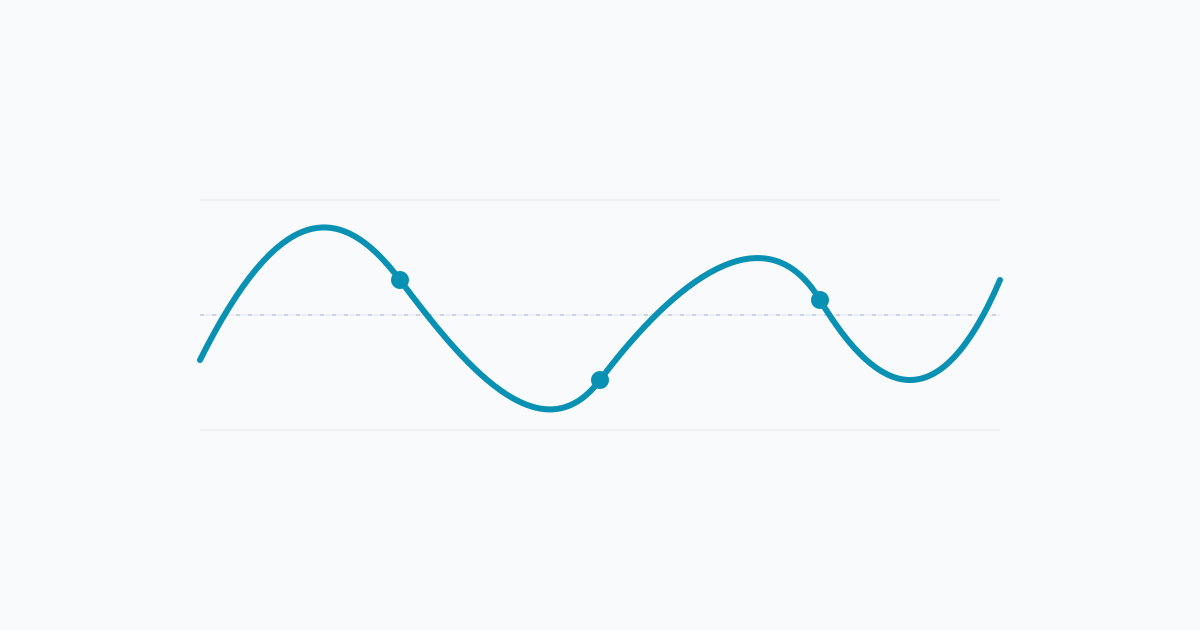
You started mood tracking on a Monday. You logged a 7, a 6, an 8. The streak counter ticked up. Then a rough patch hit, and for two weeks the only honest number was a 2 or a 3. You did not want to type that in every day, and you did not want to break the streak. So you stopped opening the app. A month later you deleted it. The counter that was meant to keep you going was the thing that pushed you out.
That is the trap. Mood tracking is one of the most useful things you can log, and one of the easiest to abandon, often for the wrong reason. This article is a calmer way to do it: what to log, what to log alongside it, what scale to pick, and a list of what not to do. It is not advice about your mood. It is advice about the practice of tracking it.
Before anything else, what this article is not
Mood is sensitive territory. So a clear line up front: this is about tracking practice, not about mood as a clinical concept.
Mood tracking is descriptive, not diagnostic. It is not a substitute for therapy, counselling, medication, or any professional support. No tracker, including Loggr, can tell you what your mood means or what to do about it. If a tool ever implies otherwise, it is overreaching. What a tracker can do is hold a record of how you felt across many days, so you can look at it later with more context than a single moment gives you. That is the whole product.
With that established, here is how to do the practice in a way that lasts.
The shift: mood tracking only works when you are allowed to be human with it
Most mood trackers default to streaks because streaks feel like progress. For mood specifically, they create a bad incentive. On a low day, a streak counter quietly asks you to inflate the number to keep the chain alive. The next time you look back, your low days look less low than they were, and the pattern you came for is gone.
The shift is small but the whole article hinges on it: honest 2s are more useful than dishonest 6s. Missed days do not break your data. Skipped days are honest gaps. A log with twenty truthful entries out of thirty is worth more than a log with thirty entries where five of them are polite fiction.
Once you accept that, everything else gets easier.
What you are actually doing when you log mood
Take a reading, not a verdict.
A mood entry is a brief description of how you felt at one moment. It is not a score of you. It is not a judgement about whether the day was “good.” It is a single data point in a long sequence, and like any data point it does not mean much on its own. It matters because, taken with the other entries on either side of it and with whatever else you tracked that day, it starts to form a shape.
The reframe is small, but it changes how logging feels. You are a person noting a temperature, not a person grading yourself.
What to log alongside mood (this is where the value is)
Mood as a single number tells you almost nothing on its own. A 4 with no context could mean a hundred different things. The value of mood tracking shows up when you log it next to a few inputs and a single line of context.
A short list that works for most people:
- Sleep. Hours, on a number field. The most common day-after effect anyone finds in their own data is “last night’s sleep relates to today’s mood.” Worth a single line at minimum.
- Energy or focus. A scale field, separate from mood. They correlate, but they are not the same. A flat mood with high energy is a very different day from a low mood with low energy, and the difference matters when you look back.
- Activity. Did you exercise? Did you have a social plan? Was it a heavy workday? A few yes-or-no fields, or one small list field with categories like “rest,” “light,” “intense.”
- Weather. It feels silly to log. Add it anyway. People who track weather alongside mood often find a relationship they did not expect.
- One-line note. A short text field where you write the sentence you would tell a friend in passing. “Slept badly, family thing at lunch.” That sentence is what makes a 4 readable in six months.
The note matters more than people think. The number is the data; the note is the index. Without it, a 3 from March is an anonymous low. With it, you remember what was going on.
How to pick a mood scale that survives a year
The scale question gets disproportionate attention online. Here is the practical version.
- 1 to 5 is easy to anchor (1 is bad, 5 is great), but coarse. You lose the difference between a regular day and a noticeably good one. After a few months, most of your entries cluster on 3 and 4, and the resolution is not there.
- 1 to 10 is more flexible, and richer for analysis, but harder to anchor. What is the difference between a 7 and an 8? Without an internal reference, you will drift. By month three, your 7s and your 8s will mean different things than they did in week one.
- 1 to 7 is the analytical sweet spot for many people. Wide enough to capture real differences, narrow enough to anchor. Loggr’s Scale field type supports custom minimum, maximum, and interval, so you can set 1 to 7 in whole steps if that is what you want.
If you go with 1 to 10, anchor it. A workable anchor: “5 is a regular Tuesday.” Everything else is up or down from there. That single sentence will keep your scale honest months from now.
Whichever scale you pick, do not change it mid-track. That is one of the most common quiet failures of mood tracking.
What NOT to do
This is the discipline section. Most of the value of mood tracking is in the things you avoid.
Do not chase streaks
Coverage matters; consecutive days do not. Twenty honest entries out of thirty are more useful than thirty in a row where five were inflated to keep the chain alive. Mute the streak if your app surfaces one. Loggr does not push streaks on you, by choice.
Do not change your scale mid-track
If you started on 1 to 7, stay on 1 to 7 for at least three months. A 5 in March and a 5 in May should mean the same thing. The moment you swap to a different range, every comparison across that boundary is fuzzy. If after three months you genuinely think the scale is wrong, change it then, but treat the change as a hard reset of the data, not a continuation.
Do not log when you cannot be honest
If you are in a state where you would type a polite number instead of a real one, let the day be a gap. A skipped day is more useful than a fake one. Your weekly coverage will dip; the patterns will still be there.
Do not expect daily insight
Mood patterns show up over weeks, not days. The first week is calibration. The second week is when you find out how stable your scale is. Real patterns become readable in month two. If you go looking for an insight after four days, you will find noise and read it as a signal. Wait.
Do not try to optimise mood directly
This is the biggest one.
You cannot push a mood number up by trying. Trying tends to make it worse, in fact, because the act of grading yourself daily on whether you feel better creates exactly the kind of pressure mood is sensitive to.
What you can do is influence the inputs. Sleep is influenceable. Exercise is influenceable. Time off, social plans, the structure of your workdays, screen time before bed: those are all things you can change. Mood is a downstream reading. You move the inputs; the reading moves on its own, or it does not, and you log what actually happened.
This is the difference between measuring your mood and managing it. Tracking belongs in the first category. Managing is a different question, and a tracker is not the right tool for that.
What patterns to look for after a month or two
By month two you have enough data for real questions. A few worth asking:
- Connections between mood and concrete inputs. Sleep, exercise, alcohol, social plans, workload. Look for differences between high-input days and low-input days. Did your mood average a 5 on the days you slept under six hours, versus a 6 on the days you slept seven plus? That gap is the useful number.
- Day-after effects. Some of what affects today’s mood was set up yesterday. Last night’s sleep is the classic. A late dinner the night before, a difficult conversation the day before. Same-day analysis misses these by definition. Loggr compares fields both same-day and with a one-day lag and keeps whichever relationship is stronger, so day-after effects surface automatically when they are there.
- Mood floor and mood ceiling. Most people have a personal range. You might find your mood almost never goes below 3 or above 8, and the bulk of your entries live between 5 and 7. Knowing that range matters more than chasing a higher number. The work is in understanding what moves you across your own range, not in trying to break out of it.
For a broader introduction to looking at your own data, the personal analytics getting-started guide covers the same logic across any field, not just mood.
A simple four-week plan
If you want a concrete starting point, try this.
- Weeks 1 and 2: create a mood field on a 1 to 7 scale and log it once a day, evening if possible. Add a one-line text field for context. That is it. Two fields.
- Weeks 3 and 4: add a sleep number field and one habit field that you suspect matters (exercise, alcohol, screen time before bed, whatever fits your life). Keep logging mood and the note. You now have four fields.
- End of week 4: open the monthly stats and ask three questions. What is my mood average and range? Where are the gaps? Is there any visible difference in mood between days when the habit was on and days when it was off?
- Decide what to do next. Maybe keep the same four for another month. Maybe drop the habit and add weather. Maybe nothing changes and you just keep going.
That is the whole loop. Track, look, adjust, repeat. The goal is a small, sustainable practice you can hold for a year, not a perfect setup you abandon in six weeks.
Key takeaways
- Mood tracking is descriptive, not diagnostic. It is not a substitute for therapy, counselling, medication, or any professional support.
- Streaks make mood tracking worse. Coverage matters, consecutive days do not.
- Honest 2s are more useful than dishonest 6s. Skipped days are honest gaps.
- A mood entry is a reading, not a verdict. The number is data, the one-line note is the index that makes it readable later.
- Log mood alongside a few inputs. Sleep is the highest-value companion field; energy or focus, an activity field, weather, and a one-line note round it out.
- Pick a scale and keep it. 1 to 7 is a good middle ground; 1 to 10 works if you anchor it (“5 is a regular Tuesday”).
- You cannot push a mood number up by trying. You can influence the inputs.
- Real patterns become readable in month two, not week one.
FAQ
Should I track mood multiple times a day?
Usually no. Once a day is enough to find the patterns most people care about, and the extra effort of two or three entries per day is what makes mood tracking unsustainable. The richer signal is not worth the cost in adherence. If you have a specific reason (a clinician asked you, you are testing a hypothesis), that is different. Most people, once a day, evening.
What if I forget to log?
Log the next day from memory only if you can be honest. If you cannot remember whether yesterday was a 5 or a 7, let it be a gap. Coverage will reflect it, and the patterns will still be readable. A backfilled guess is a fake data point.
How long before mood data is useful?
A month is the honest answer. Weekly stats will be readable sooner, in the “is my coverage holding up, am I using my scale consistently” sense. Real connections to other fields need enough samples to be real and not coincidence. Loggr starts surfacing patterns once it has the data it needs for each pattern type; if there is not enough yet, it tells you what is missing rather than guessing.
What scale should I use, really?
If you do not want to think about it: 1 to 7, evenings, with a one-line note. If you already have a preference, stick with it. The worst scale is the one you change after six weeks because you read about a different one. Consistency beats choice here.
Does Loggr give me mood advice?
No, by design. Loggr describes patterns in your own data, in plain language. It does not interpret what those patterns mean for you, and it does not tell you what to change. The interpretation is yours, and so is any decision that comes from it. If you want guidance about your mood itself, that is a conversation for a therapist, counsellor, or doctor, not an app.
What if my data shows me something I do not like?
That is one of the points of the practice. You do not have to act on anything you find. Sometimes the only value is more accurate self-knowledge. If a pattern is genuinely concerning, it is information you can bring to someone qualified to help, which is more useful than not knowing.
Try it for two weeks
Open Loggr, add a mood field on a 1 to 7 scale, and log it for two weeks. Add sleep and one habit alongside it for the second two weeks. After a month, open Loggr and look at the connections between them. Not for a verdict, not for a fix, just for a clearer picture of your own data than you had before. If the picture is useful, keep going. If it is not, you have lost one minute a day and learned something about the practice. Either way, no streak to defend.